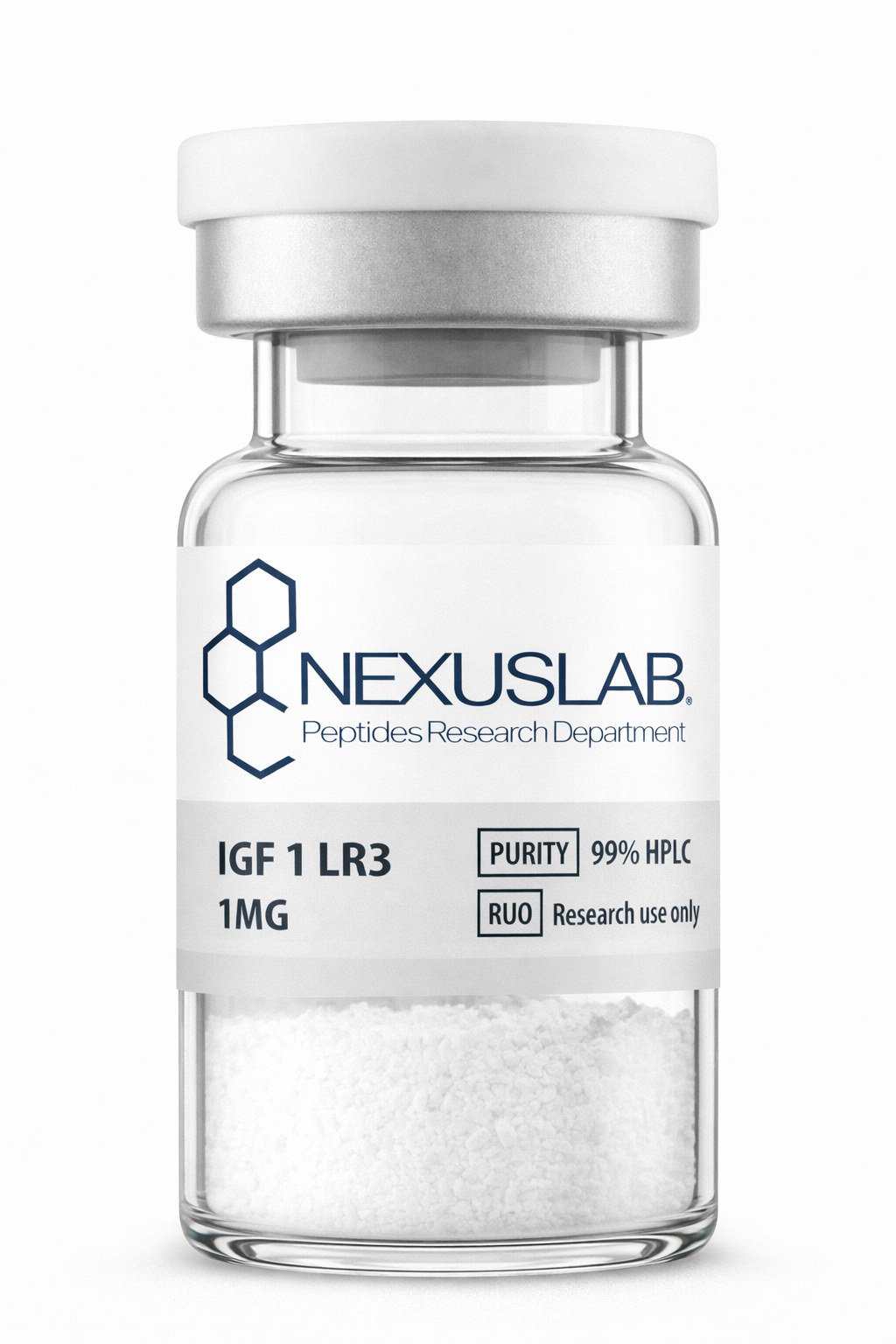
Research peptides · Specialized research compounds
IGF1-LR3
Available documentary data and items still to verify are detailed below.
Price incl. VAT€115.00
AvailabilityAvailable
SKUIGF1-LR3
Loading availability…
 0
0
Research peptides · Specialized research compounds
Available documentary data and items still to verify are detailed below.
Loading availability…
02 — Information to verify
IGF-1 LR3, or Long-[Arg3]-IGF-I, is an 83-amino-acid IGF-1 analogue. It contains a 13-residue N-terminal extension and a Glu3→Arg substitution in the IGF-1 portion. Research uses include growth-factor studies in cell-culture systems.
Technical data
Catalog format: 1 mg. The sequence is verified against BMRB entry 4494. The listed formula is calculated for the chain with three disulfide bonds; the fully reduced chain contains six additional hydrogen atoms. Reference CAS: 143045-27-6; UNII: M9L22Y19H9.
Structure not available.
Reference molecular data.
Formula and theoretical average mass calculated from the 83-residue BMRB sequence with three disulfide bonds, free termini, and no counterions. The reduced chain has formula C400H625N111O115S9 and theoretical average mass 9117.6 g/mol. The PubChem reference is a substance SID, not a CID.
The modifications are studied for their effects on IGFBP binding and IGF-1-receptor signalling. The NMR structure describes molecular folding. The literature also includes physiological studies in sheep models.
The MFPAMPLSSLFVN extension precedes the 70-residue modified IGF-1 portion. Arg3 numbering refers to that portion, not the entire 83-residue chain. The modifications were developed to alter interaction with IGF-binding proteins while retaining investigation of IGF-1-receptor responses.
IGF-1R activation connects with PI3K/AKT and MAPK pathways involved in survival, growth, and metabolic responses. Culture studies distinguish viability, cell number, and protein production. Results obtained with native IGF-1 are not automatically experimental findings for the LR3 variant.
The 2023 study compares fetal-sheep insulin secretion with isolated-islet responses after acute LR3 exposure. The in-vivo decrease does not persist in the same way in isolated islets. Comparison with prolonged-exposure studies shows why duration and experimental environment change interpretation.
In bovine follicular cultures, LR3-IGF1 has limited effects on endothelial-network growth and a small effect on proliferation. Receptor blockade with picropodophyllin markedly reduces networks and progesterone. This highlights receptor-system involvement without showing that adding LR3 produces a strong angiogenic effect.
The bibliography includes fetal growth, nutrient availability, muscle, and IGF-axis genetics. Some studies use sheep recombinant IGF-1 or exercise, others LR3. Genetic data in athletes describe associations; they do not demonstrate benefits from peptide administration or equivalence among IGF forms.
10.3389/fphys.2022.954948 10.1519/JSC.0000000000004102 10.1152/ajpcell.00344.2021
Catalog of products presented for research activities. Not for human or veterinary use. This notice does not replace verification of applicable rules.